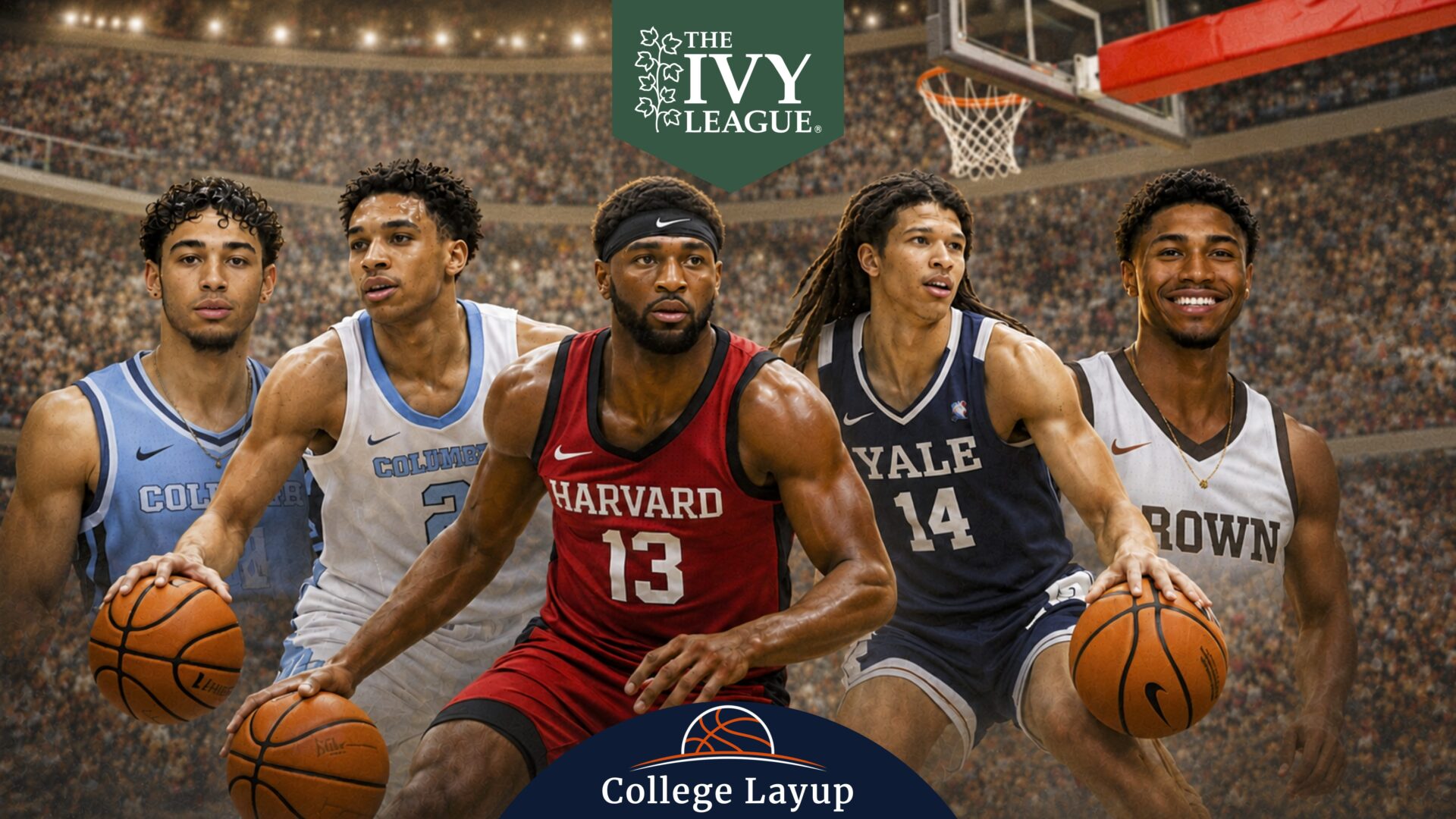
Highlighting and analyzing five Ivy League players who’ve exhausted their collegiate eligibility and possess translatable, effective skill sets to contribute at the professional level—either domestically or abroad. Each player has a clear offensive or defensive strength, along with one or more areas for improvement that may raise some concern.
I only included players that I scouted live this past season. I did not scout Penn, Cornell or Dartmouth.
In no specific order. I’m sure there are more players who will play professionally; these are five who caught my eye.
Blair Thompson — SF, 6’8”, 210 lbs
Columbia
Senior Season:
31 MPG, 11.4 PPG, 4.8 RPG, 50% FG, 41% 3PT (4 attempts per game)
Translatable skill: Catch-and-shoot 3-pointers
It’s obvious when you watch him live and on film that Thompson is a catch-and-shoot maestro. Even still, this stat per BartTorvik.com caught my eye: Thompson shot 45-110 (41%) on 3-pointers this season, and 100% of his makes were assisted. For better or worse, every single three he made was a catch-and-shoot jumper.
The good: he can shoot coming off pin-downs, stagger screens, etc, and he has good size and form to rise over defenders and get his shot off.
The “bad”: Opponents who chase him around (he’s not incredibly quick) or close-out with length can stifle Thompson. I don’t have his off the dribble statistics available at this moment, but it’s clear he’s not someone to put the ball on the floor.
He simply wasn’t able to display the ability to take his man off the dribble in four years in the Ivy League — he didn’t have a pull-up jumper (whether one dribble pull-up or more than one-dribble) and didn’t create in the midrange using his handle. His baskets were all either in transition, cutting to the hoop, or catch-and-shoot. He needs a middle game. He’s clearly a smart young man, earning a spot on this year’s Academic All-Ivy team, perhaps indicating a strong ability to focus, but he needs to expand his game to be fully effective. He’s already a sniper on the catch-and-shoot, though.
Defensively, he was able to guard his man in the Ivy League, but to speculate one way or another on his defensive ability without in-person testing or evaluation against certain levels of competition would be a bit premature at this point.
Catch-and-shoot 3-pointers
Finishes at the basket (very few off the dribble or start-to-finish moves)
Landon Lewis — PF, 6’7”, 225 lbs
Brown
Senior Season:
31 MPG, 16.6 PPG, 7.2 RPG (2.5 ORPG), 55% FG
Translatable skill: Back to the basket scoring
Lewis is an aggressive post presence, using a strong build and quick feet to get whatever he wanted in the Ivy League this season. He also posted 17 points and 8 rebounds vs. Providence in a close non-conference game early in the year. He needs to continue developing his 15-foot jump shot so he’s not limited to back to the basket scoring and driving through the lane to finish at the rim. At 6-7, he’s somewhat undersized against certain frontlines, but he remains a player worth watching who can contribute on many overseas teams due to his consistent quickness, strength, and soft left-handed touch. He’s also a determined rebounder, leading the Ivy in offensive rebounding.
Defensively, Lewis is difficult to evaluate because there were few, if any, big men in the Ivy League who matched up with him this season. Most teams were thin in the frontcourt, especially compared to power conference lineups that often feature multiple players who are 6-9 or taller.
Kenny Noland — PG, 6’2”, 180 lbs
Columbia
Senior Season:
33 MPG, 17 PPG, 3.7 APG, 3.4 RPG, 1.4 SPG, 92% FT, 38% 3PT
Translatable skills: Slithering to the hoop for layups, and also quick-release 3-pointers
Noland finished second in the Ivy League in scoring as a diminutive guard, and he was clearly the player Columbia relied on in pressure moments. He did a strong job as a senior captain this season, and Coach Hovde has publicly acknowledged that Noland was an extension of the coaching staff on the court.
Offensively, Noland can get into gaps and to the rim with his quickness and slithering style. He was able to finish at the rim consistently in the Ivy, which was encouraging, but he struggled against power conference teams when finishing over taller front lines. His size caught up with him at times.
He needs to develop a floater and more variety as an interior finisher instead of relying on layups. At his size, he can’t rely exclusively on finishing at the rim. Only 34 of his 179 two-point attempts this season came from outside the paint (per BartTorvik.com), highlighting his undeveloped floater and midrange game.
Quickness in his shooting and driving
Undersized
Casey Simmons — SF, 6’7”, 180 lbs
Yale
Senior Season:
26.5 MPG, 10.5 PPG, 4 RPG, 56% FG
Ivy League Defensive Player of the Year
Translatable skills: Defensive switchability, pick-and-roll defense, fighting through screens, alertness, ability to generate steals, and offensive cutting and slashing, along with an interesting 3-point jump shot (unusual form and a somewhat slow release, but it appears relatively effective).
Simmons is an elite defender regardless of the level of competition. He’s long, fast, aggressive and smart. He’ ‘s 6-7 with slinky-like arms, and he locks up. He can turn defense into offense in transition, and offensively, he’s an excellent slasher who routinely finishes with head-at-the-rim dunks—more with natural spring than explosive force. He’s one of those guys who changes the entire cadence of the team defensively and his impact goes beyond the box score.
Simmons needs to develop his ball handling and in-between game, starting with improving his base so he can operate with more patience and control in a triple-threat stance. That’s not to denigrate his game—he just needs a bit more decisiveness with the ball in his hands on the perimeter. He’s a capable catch-and-shoot 3-point shooter, but his in-between and off-the-dribble game need work. Only 33 of his 169 two-point attempts this season came from outside the paint, and he picks up his dribble with no real read too often in the midrange.
He needs to be able to make plays in the half court with the ball in his hands—not just rely on catch-and-shoot threes, cutting, and straight-line drives. Professional teams have the length and athleticism to limit that, so he needs to develop a pull-up jumper or some form of an in-between game. But the defense is already there.
Defense (not only blocks and steals, but he fights through screens and stays with his matchup)
Offense, Driving and Cutting, and Athleticism
Shooting
Chandler Piggé — SF, 6’5”, 210 lbs
Harvard
Senior Season:
33.6 MPG, 13 PPG, 5.1 RPG, 3.3 APG, 1.7 SPG, 46% FG
Translatable skills: Passing/court vision. He has muscle and quickness as a team-oriented point forward who spreads the ball with precision. Defensive activity all over the floor, with a knack for getting into passing lanes and providing strong help defense. Rebounds well from the perimeter and pushes in transition, either as the ball handler or running the wing. Piggé can guard inside and out due to his combination of quickness and exceptional strength. He’s also a decent shooter, making one 3-pointer per game and looking like somebody who’s relatively comfortable when he needs to shoot the ball. Not necessarily a proficient shooter, but not a deficient one either.
Areas of improvement: He needs to develop a pull-up jumper or some form of an in-between game. He doesn’t show much ability to break down his man to create, outside of using his strength, which won’t translate consistently at the professional level. Adding one or two reliable perimeter moves would expand his impact. He’s also a bit undersized at 6-5, but he routinely defended bigger players in the Ivy and held his own due to his strong physique.
Passing/Vision
Defense — steals and finishes
Offense – Cutting, driving and finishing
Shooting