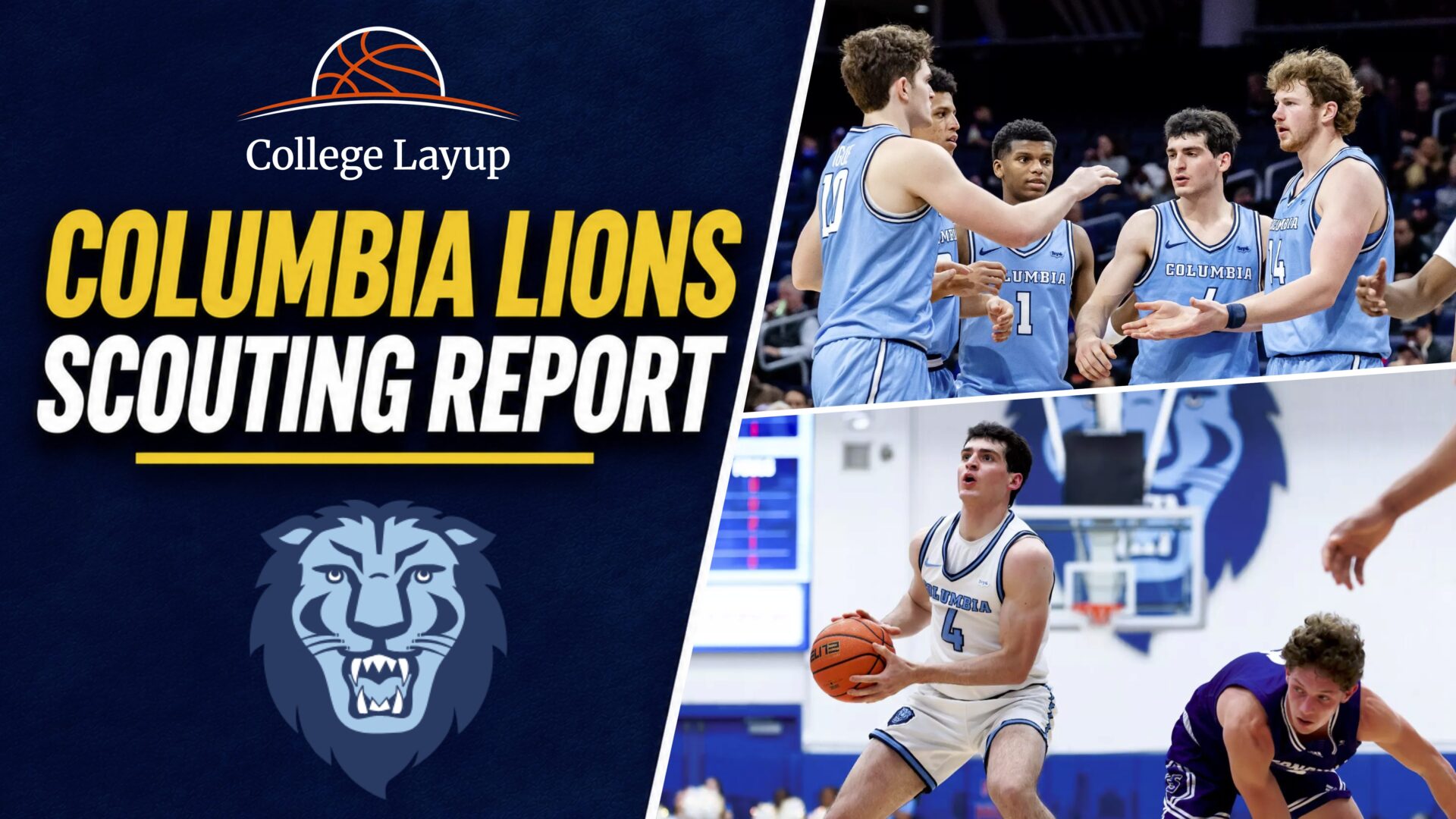
Five games into the season, here’s a deep dive into Columbia basketball. Breaking down the Lions’ personnel, team makeup, strengths, vulnerabilities and overall outlook.
They are 4-1 and most recently defeated Northwestern 75–53 on the road.
The Ivy League will present a difficult challenge. Harvard has high-major talent across its roster, Penn has a few players of that caliber and returns four starters from an NCAA Tournament team, and Princeton returns its entire core.
Through five games (four against DI opponents), the Lions have established a baseline for what their personnel looks like, how the pieces fit together, where they’re strong, and where they might be vulnerable. I’ve seen Columbia live twice this season, and five times last season.
Breakdown:
First—and most importantly—I want to extend my sincere prayers to sophomore shooting guard Miles Franklin.
This week, the team announced Franklin is on medical leave from the program after being diagnosed with B-cell non-Hodgkin lymphoma. It’s an intense roadblock and challenge for a young man with so much promise, not only on the hardwood but by all accounts in general. I’ve never met Franklin, but regardless, as a fellow human being, you only want to see him get back to full health as quickly and easily as possible. My prayers are with you, young man. Coach Hovde’s statement speaks for itself on the character of Franklin and the support the program will provide throughout this process.
Onto the analysis for this year’s team:
The most important players for Columbia are Mason Ritter, Gerard O’Keefe, Josiah Cunningham and Connor Igoe. The team’s ceiling will depend on how far these four can elevate their individual games, complement one another, and answer the call.
Mason Ritter
Previous evaluation of Ritter here.
Ritter, a 6’9”, 250-pound interior player, is Columbia’s only real interior presence—and he’s a good one to have in the Ivy League. I was looking forward to scouting him this season after he finished 66% of his rim attempts as a sophomore, and so far, he’s continued right where he left off.
He can score over either shoulder using his hook shot, and he’s mobile and skilled enough to be a scoring threat in the short roll as well. Pair that offensive touch with muscle to set effective screens as well as grab rebounds, and add in an impressive bounce to block shots, and Ritter is quietly a top-tier big in the Ivy League. He posted 12 points and 7 rebounds (50% shooting) in 24 minutes vs. Northwestern.
For Columbia to have success this season, Ritter will need to establish himself in each and every game, and that won’t be easy to do considering he might not get a lot of help inside. Ryan Soulis and Zine Bedri are not on this year’s roster, so it’s really up to Connor Igoe and Douglas Langford—both of whom we’ll cover below—to help complement Ritter.
Ritter often plays alongside 4 perimeter players so Columbia is often bare down low simply because of who’s on the floor. Igoe is more of a basket-facing point forward and Langford is still getting his feet under him after transferring into the program from San Jose State.
Along with Gerard O’Keefe (Columbia’s sharpshooter who we’ll cover below), Columbia will rely on Ritter to carry a heavy burden this season.
The Lions will face several good big men in the Ivy League this year (TJ Power at Penn, Thomas Batties II at Harvard, to name two) and they will have an answer of their own in Ritter. To what level he can score offensively and to what extent others help him out—scoring or rebounding—will be a determining factor in how competitive this team is.
When the Lions face any two-big lineups, it could become problematic for them defensively, unless Igoe or Langford can provide enough size and strength down low to complement Ritter.
Gerard O’Keefe
O’Keefe is Columbia’s sharpshooter, and so far this season, its best scorer. He’s averaging 16.4 points on 56% shooting. When Kenny Noland transferred to Michigan, the Lions lost their most established perimeter creator, someone who could consistently generate advantages off the dribble. That’s why O’Keefe’s shot generation—even if it’s for himself—has been a lifeline for this team. He’s delivered with 3-point shooting and shooting off screens.
The junior is converting 50% of his threes (4.8 attempts per game) and 60% overall on all jump shots (31-52). Despite being only 6’3”, O’Keefe maneuvers into tight spaces with the ball and can pull-up from anywhere in the half court, at least against the competition he’s facing.
It doesn’t always look pretty, but his shooting stroke off-the-dribble must be recognized.
O’Keefe doesn’t have a flashy handle to break down his defender and create separation, but he creates advantages with constant movement off screens, elite conditioning, and a quick-fire release.
If O’Keefe hadn’t taken a leap this season, it’s fair to wonder where Columbia would find consistent perimeter scoring. Thus far, he’s come through for the team.
I do have concerns, though, as it relates to how the team will generate offense if he has a poor shooting night, or when opposing defenses take away his ability to catch the ball on the go. Who else can manufacture enough points when opposing defenses take O’Keefe away?
Josiah Cunningham
A 6’2”, 190-pound lead guard, Cunningham comes off the bench but is trusted as one of Columbia’s best players this season. He attacks, absorbs contact and finishes at a relatively high level for an Ivy League guard (16-19 (84%) on layups this season, 67% from the field overall, 10.8 PTS/2.6 REBS in 14 MPG).
Nobody would think twice if Cunningham started. But Cunningham coming off the bench gives Columbia an attacking guard to put pressure on second-unit defenses and also gives Cunningham more freedom to attack the basket. How consistently Cunningham plays as the season continues, especially if he doesn’t touch the ball that much but then would help the team by stepping up and making a timely play, will also influence whether or not Columbia can sustain its winning.
Connective Tissue of the Team
Connor Igoe
A 6’8”, 235-pound point forward, Igoe is a facilitator who sets up his teammates on cuts and off-ball movement. Igoe usually operates at the top of the key, where he scans the court, swings the ball, delivers pinpoint passes, and provides inside-outside offensive capability.
I’ll be watching closely to see if he can establish a two-man game with Ritter, particularly through high-low opportunities and facilitating to Ritter around the basket. That would provide another offensive avenue and be a big boon to this team’s offensive makeup.
New faces who fill holes that otherwise would make this team vulnerable
Michael Madueme
A 6’5” swingman with long arms and some muscle on his frame. He’s only a freshman, but he has potential to develop into an active wing defender and rebounder. Madueme needs to slide his feet more defensively, and use his hands less. But he has good defensive processing and seems to be a relatively tenacious defender.
Madueme has yet to display much offensively, and that’s mostly because Columbia’s upperclassmen take the bulk of the team’s shots.
Josh Pratt
Pratt—also only a freshman—creates separation for pull-up jumpers using a fluid handle and good body control. He needs to add muscle to his frame to lean into contact more, but nevertheless, Pratt provides off-the-dribble flair that the Lions lack, especially with Franklin out. He’s shown flashes of being a skilled shot taker and maker in his short time playing college basketball.
He’s only played five college games, but Pratt has been a starter, maybe because the Lions will need offense wherever they can get it, and perhaps because the coaching staff really believes in his ability to develop into a starter in this league.
The Lions will probably need his offensive production to win games in the Ivy League, especially if Franklin is not available.
Douglas Langford
A 6’8”, 245-pound forward, Langford will need to sustain his rebounding production (6.8 RPG) for Columbia to have prolonged success this season. Langford can battle through contact for rebounds, and he’s shown some ability to finish put-back attempts, too. The Lions need another interior presence to complement Ritter, and they will give Langford all the opportunities to fill that role.
Gabe Hornberger
A 6’4” freshman with a high release point on his jumper, Hornberger plays with a good pace off the ball to be shot-ready. That said, he’s only 3-for-18 from the field this season (in 11 minutes per game).
Even still, I wouldn’t be surprised if Hornberger was given more opportunities to find his rhythm in the next few games. The Lions likely will want to develop him through game reps and also want to see what he can bring to the program. If he’s a shooter, what type will he be? Is he primarily a spot-up shooter, or can he become a movement shooter, too?
Point Guard who can help the team get into its actions, make winning plays and provide veteran steadiness
Hampton Sanders
Sanders is a former Division III player at NYU and his transition to Division I has gone well since he arrived last season. The point guard is only 6’0”, but he’s comfortable initiating offensive actions, and he’ll sometimes make you pay if you go under on pick-and-rolls. Sanders is averaging 8.6 points and 5.0 assists against 1.6 turnovers per game. His ability to organize the offense and make the right reads gives Columbia some veteran steadiness that it needs.